CRIN - Child Rights Information Network

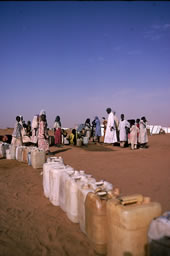
"In this new century, water, its sanitation, and its equitable distribution, pose great social challenges for our world. We need to safeguard the global supply of healthy water and to ensure that everyone has access to it."
Kofi Annan, United Nations Secretary-General
Access to clean affordable water is not only critical for domestic use and nutritional health. Many people also depend on water to make a living raising livestock, growing crops or for small-scale industries which are often household based. Water scarcity is becoming the starkest barrier to human development. A billion people live without access to an adequate water supply, a further 2.5 billion lack access to adequate sanitation (WHO 2000). Rights-based approaches to development treat water as a universal right that is essential for the fulfilment of other human rights. These include the right to health, the right to work and the right to life.
Adopting a rights-based approach forces practitioners to focus both on the access to water and sanitation of a whole communities or certain disadvantage groups inside a community. This approach will highlight for example the discrimination suffered by people with disabilities or ethnic minorities or problems elderly might face with collecting their own water or access public sanitation facilities. A UN Independent Expert on the issue of human rights obligations related to access to safe drinking water and sanitation was established by the Human Rights Council in March 2008.
On 30th September 2010 the UN Human Rights Council adopted a resolution by consensus affirming that water and sanitation are human rights. Before that only two of the core international human rights treaties explicitly recognise this right: the Convention on the Rights of the Child and the Convention on the Elimination of All Forms of Discrimination against Women.
A key way in which humanitarian and human rights standards can be applied is in training and capacity building, influencing water policies and community participation. This means identifying and addressing the needs of particularly vulnerable population groups. Children are particularly at risk, many millions dying each year from preventable water-borne diseases such as cholera and typhoid. The privatisation of water supplies is further jeopardising access to water. Even in wealthy countries, people living in deprived urban areas, who cannot afford to pay the exorbitant cost of maintaining water supply infrastructure, lack enough water to meet their basic needs. Rights-based approaches call for an integrated solution which invites the participation of communities, private companies and the government to establish a legal framework which facilitates accountability and transparency
A rights-based approach to water: Identifying power disparities: Tanzania
WaterAid has been implementing a project to improve water access for residents in the Kileto District. Kileto District is made up of three main groups: hunter-gatherers, pastoralists and agriculturalists/farmers. Competition between the three different ethnic groups in Kileto over water resources is a source of social and political conflict. The power difference between these groups significantly determines their access to water services.
Using a human rights-based approach to programming enabled WaterAid to identify the deeper issues that prevented access to water in Kileto, including power imbalances, lack of land rights and exclusion from national policy decisions.
A Human Rights-Sensitive Strategy was developed to incorporate the following:
Participatory methodology: Through involving each ethnic group in the analysis and assessment stage of the project, WaterAid was able to identify each group’s different water needs.
Understanding the social context: Participatory assessment and planning methodology enabled WaterAid to develop an understanding of the power relations that existed between the different ethnic groups and the power imbalances that existed within each group: in particular between men and women, and the rich and poor. By bringing all stakeholders in the water project (including local and national authorities responsible for water policies) into the discussion, WaterAid was also able to improve understanding between each group.
Advocacy: In order to influence national policy and practices, WaterAid developed a coherent advocacy strategy in Tanzania, which included working with and training national government staff responsible for water services and policies.
Understanding the political and legal context: Through analyzing the political and legal context in which they were working, WaterAid was also able to understand how national policies and legal issues positively and negatively affected the access of these groups.
Discussion with all stakeholders: To explore and understand these issues sufficiently, WaterAid found that considerable time and effort had to be invested in discussions with and between the Kileto partnership management team, field staff, and project communities.
Partnership building: To achieve genuine community management of water services, an important strategy was building partnerships with civil society organisations and training them in the planning and implementation of the programme so that they could achieve autonomy in the future.
Source: The Right to Water and Sanitation
 Print page