



Click here to find a helpline in your country, someone you can talk to about problems you have at school, in your family, or in your community.
Also, visit TeenIssues, a UK-based website which offers answers and practical advice on issues experienced by teenagers. Features are written by professional journalists and experts - who have a particular interest, or a background in this area.
*** Internet Safety: Report online child abuse HERE ***
Learn how to stay safe while talking to your friends and meeting new people online:
- Think You Know website
- Childline online and mobile safety page
- Chatdanger website on how to keep safe while chatting online
The Convention
"Rights" represent things that every child in the world should be able to do or to have. All children have the same rights. They are listed in the Convention on the Rights of the Child.

All countries in the world haves agreed to these rights except two: the United States of America and Somalia.
- To learn more about your rights and why they are important, visit the Voice of Youth website, in English, French and Spanish
- Scotland's Commissioner for Children and Young People has a website that can help you better understand your rights
-
Read about your rights in other languages:
Convention on the Rights of the Child - Karen language (Knowing Children)
Convention in 58 languages (Magic website)
Check our A to Z of children's rights issues
CRIN
CRIN stands for the Child Rights Information Network. CRIN is an international network of 2000 organisations that share information about children's rights in order to improve the situation of children worldwide.
The CRIN office is in London, in the United Kingdom, and five people work there full-time to operate the network and coordinate the information. You can contact us here.
CRIN provides information services to child rights professionals and children: an enquiry service (email info@crin.org), a news service, a calendar of events, a publications catalogue. We also produce regular email bulletins, Newsletters and other material designed to help and inform people who work for children.
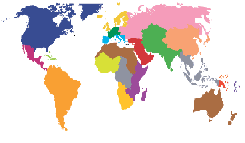
Click on the map to go to our Regions page and look for information on children's rights in your region and your country!
Get involved
You can contact Youth Organisations in your country to get involved in their activities.
Visit UNICEF's Magic website, a site devoted to children's participation in the media. It gives information about how children can get their voices heard, it has a calendar of events for children, offers media resources for young people and an email group.
Visit Save the Children's School Link website, where you can learn about the lives of children in other countries, play fun games and read stories written by children themselves.
The Youth Voice site invites you to have "your shout" by expressing your opinion through useful local, national or international organisations.
WOFCHA, the World’s Financial Challenge, is a space where youth influence and feedback on the financial issues and policies that most matter to them.
In the classroom
Tell your teacher about websites and resources they can use to teach the class about the rights of children in the world. Click on the picture and find lots of educational resources for teachers.
Have fun!
CRIN compiled a list of educational games and activities for children to learn about their rights and about children's rights issues (below). The latest resource added appears at the top of the list below, so keep checking for new games.
Here are some of the most interesting games:
- Know your rights game -This is an interactive game about the United Nations Convention on the Rights of the Child (UNCRC).
- Childline - You can play games, watch videos, try out the creative tools
- Cyber Dodo - Also available in French, Spanish and Arabic
- WaterAid - Learn what's so special about water, loos and soap? They keep you safe from millions of tiny bugs found in - you guessed it – poo!
 24/09/2013 - A Europe-wide campaign to establish a European Anti-bullying Day launched
 06/05/2013 - World Youth Summit 2013
 11/12/2012 - NEW ZEALAND: Our view matter - children and young people talk about solutions to poverty
 Children's Rights WIKI
 CRIN on Twitter


 Send to a friend